Abstract
Traditional sales management often focuses on hitting simple targets, ignoring the complex human strategies
behind the numbers. This paper introduces Strategic Performance Distance (SPD), a new
framework that treats sales as a strategic game between managers, agents, and their peers. By applying game
theory principles, SPD creates a single score that measures not just what an agent achieves, but
how sustainably and competitively they achieve it. We demonstrate how this approach transforms
performance management from reactive tracking into proactive coaching, using real-time transparency to drive
a healthy "race to the top" among teams.
Keywords: Strategic Performance Equilibrium, Nash Equilibrium, Game Theory, Sales
Performance, Hyper-Competition, Real-time Observability, Producer Framework
1.Introduction
Sales performance management has traditionally relied on simplistic target-achievement models that fail to
capture the complex strategic interactions present in modern sales environments (Rackham, 1988; Dixon & Adamson,
2011). While game theory has been extensively applied to pricing strategies and market competition (Tirole,
1988), its application to internal sales performance evaluation remains underexplored.
This paper introduces Strategic Performance Distance (SPD), a metric inspired by potential game theory that
addresses three critical gaps in current sales performance management:
1. Unified Performance Measurement: A single metric to see the overall health of agent's
activities.
2. Balanced Strategic Dynamics: A model that accounts for both working with managers
(collaboration) and competing with peers
3. Real-time Team Visibility: Using mobile technology to instantly track organizational health
and competitive energy
Our contribution lies in translating the mathematical rigor of Nash Equilibrium Distance into a practical
management tool that maintains theoretical soundness while delivering operational value and enabling
unprecedented competitive performance orchestration. The framework has been implemented and validated within the
Activity Builder module of Producer Framework, a comprehensive SaaS platform for sales performance management.
1.1Literature Review
While game theory has deeply influenced organizational economics (Myerson, 1991; Bolton & Dewatripont, 2005), its
application to sales performance remains limited. Our work bridges this gap by adapting the concept of measuring
"distance to equilibrium" from potential games (Monderer & Shapley, 1996) to the practical domain of sales
management. Unlike traditional models that focus solely on output (Zoltners et al., 2001), SPD quantifies the
stability of the strategy itself, assessing how close an agent is to an optimal balance of effort,
target achievement, and sustainable collaboration.
2.Producer Framework Architecture
2.1Platform Overview
Producer Framework represents a comprehensive SaaS solution for sales performance management, designed around
modular architecture principles. The platform consists of several interconnected modules:
• Activity Builder: Template design and metric configuration
• Performance Dashboard: Real-time SPD monitoring and visualization
• Analytics Engine: Historical trend analysis and predictive modeling
• Intervention Management: Automated coaching recommendations
2.2Activity Builder Module
The Activity Builder module serves as the foundation for SPD implementation, providing:
1. Dynamic Template Creation: Configurable metric templates accommodating diverse sales
processes
2. Key Metric Selection: Flexible designation of critical performance indicators from broader
metric sets
3. Ratio Metric Support: Derived metrics calculated from base activity measurements
4. Threshold Configuration: Customizable zone boundaries for organizational adaptation
The module's architecture enables seamless scaling from small teams to enterprise deployments while maintaining
consistent mathematical foundations.
3.Theoretical Framework
3.1Multi-Level Strategic Game Model
We model the sales environment as a three-level collaborative and competitive strategic game:
Level 1: Manager-Agent Consensus Game
• Players: Manager (M), Agent (A)
• Objective: Achieve collaborative agreement on performance metrics and targets
• Manager strategy space: Metric template design, target setting, collaborative engagement
• Agent strategy space: Consensus participation, feedback provision, commitment level
• Success condition: Psychological safety and strategic alignment achieved
Level 2: Intra-Agent Optimization Game
• Players: Agent's "Better Self" (B), Agent's "Struggling Self" (S)
• Objective: Achieve performance optimization while maintaining psychological well-being
• Strategy space: Time allocation, motivation management, sustainable effort levels
• Success condition: SPD = 0 achieved in emotionally healthy manner
Level 3: Inter-Agent Hyper-Competitive Game
• Players: Multiple agents within teams and across the organization
• Objective: Achieve superior performance through competitive excellence
• Technology enabler: Real-time mobile observability creating hyper-competitive environment
• Strategy space: Performance benchmarking, competitive positioning, collaborative learning
• Success condition: Collective performance escalation while maintaining individual equilibrium
3.2Strategic Performance Equilibrium
Building on the game model defined in Section 3.1, we define Strategic Performance Equilibrium (SPE) not as a
static state, but as a dynamic balance where an agent simultaneously achieves consensus (Level 1), personal
optimization (Level 2), and competitive viability (Level 3).
Collective SPE is achieved when:
• Individual agents maintain SPD ≥ 10 (personal equilibrium)
• Manager-agent relationships remain collaborative (relationship stability)
• Group competitive dynamics drive collective performance upward (competitive equilibrium)
• Time-series SPD patterns demonstrate sustained organizational health (systemic equilibrium)
Strategic Innovation: Unlike traditional Nash Equilibrium's static stability focus, SPE actively
leverages real-time competitive visibility to create dynamic performance escalation while preserving individual
and relational equilibrium foundations.
Formally, for agent i with strategy si, targets Ti, and
performance outcomes Ai:
Definition 1 (Strategic Performance Equilibrium): A strategy profile s* is in Strategic
Performance Equilibrium if for all agents i:
ui(si*, s-i*) ≥ ui(si, s-i*) ∀
si ∈ Si
Where each variable represents a key component of the sales environment:
- ui (Utility): The agent's net satisfaction (Score + Income - Effort Cost).
- si* (Optimal Strategy): The balanced performance plan (e.g., 60 calls/week).
- s-i* (Context): The fixed strategies of the Manager (targets) and Peers
(competition).
- si (Alternatives): Any other strategy (e.g., burnout or slacking).
- Si (Possible Moves): The full range of actions available to the agent.
Simply Put: "Given the current incentives and what my peers are doing, my best strategic move
is to maintain this performance level."
The Utility of this Formula: This formula serves as a framework for **collaborative strategy
derivation**. By establishing authentic consensus, it allows the manager and agent to
mathematically
determine the best path forward. It proves that when meaningful agreement is reached, an agent will
rationally prefer the optimized strategy over underperformance or burnout.
- When the condition is MET: The collaboration has produced a stable path where high
performance is the natural, sustainable outcome.
- When the condition FAILS: The strategy is unstable, signaling that the manager and
agent need to re-engage to align targets with reality.
3.2.1Practical Application of Strategic Performance Equilibrium
In practice, SPE functions like the relationship between an elite coach and an athlete, requiring a sophisticated
balance across three dimensions:
1. Manager-Agent Consensus (The Foundation): Before optimization can occur, authentic agreement
on metrics must be established. Without this "psychological safety," agents engage in hidden gaming rather than
open performance partnership.
2. Multi-Level Optimization (The Strategy): Once consensus is secured, the agent optimizes on
three levels:
• Collaborative Alignment: Responding efficiently to managerial coaching.
• Internal Equilibrium: Balancing high effort with personal sustainability (avoiding burnout).
• Competitive Excellence: Using real-time peer transparency to drive performance without anxiety.
3. Iterative Growth (The Result): Sustainable high performance (SPD ≥ 10) builds trust, allowing
manager and agent to continuously refine targets and strategies, replacing guesswork with evidence-based
calibration.
3.2.2Numerical Example of Strategic Performance Equilibrium
To illustrate the practical application of the equilibrium formula, consider a scenario where Agent Sarah must
choose between three performance strategies for her weekly cycle (6 working days). Her baseline objectives are
60 Calls (10/day) and 12 Appointments (2/day).
Part 1: The "Rules of the Game" (Incentive Structure)
The strategic environment is defined by the following point allocation:
- Outcome Target (+10 Points): Hitting the key result (12 Appointments).
- Activity Target (+5 Points): Hitting the volume goal (60 Calls).
- Effort Cost (-1 Point/10 calls): The energy expenditure.
- Consensus Fit (-3 to +5 Points): Agreement on strategy.
- +5 (High Efficiency): Smarter work, sustainable pace.
- 0 (Neutral): Standard expectations met.
- -3 (Waste/Burnout): Inefficient use of leads or sustainable pace.
Part 2: The Strategy Scorecard (Layperson View)
Comparison of Sarah's three available strategies:
| Strategy Choice |
Targets Met
(Appts +10, Calls
+5) |
Energy Cost
(-1 pt/10 calls)
|
Consensus Fit
(-3 to +5) |
Total
Score
(Utility) |
s₁: The Grinder
(High Volume: 80
calls → 12 Appts) |
Both Met
(+15) |
High
Burnout
(-8) |
Inefficient
(-3) |
4 |
s₂: The Sniper (Winner)
(High
Efficiency: 40 calls → 12 Appts) |
Outcome Only
(+10) |
Low Cost
(-4)
|
Smart
Work
(+5) |
11 |
s₃: The Balanced
(Standard: 60
calls → 12 Appts) |
Both Met
(+15) |
Med Cost
(-6) |
Neutral
(0) |
9 |
Note: Strategy s₂ demonstrates
that missing a vanity target (Calls) to optimize for efficiency is the rational equilibrium choice when
Manager Consensus supports "Smart Work."
Part 3: Formal Verification (Technical View)
For the technical reader, we verify this outcome by plugging these variables directly into the SPE definition:
ui(s) = (Targets) - (we × Effort) + Consensus(s)
Testing the Equilibrium Strategy s* (The Sniper):
ui(s2*, s-i*) = (10) - (1 × 4) + 5 = 11
Verifying the Inequality condition ui(s*) ≥ ui(s) against alternatives:
- vs The Grinder: 11 ≥ 4 (True)
- vs Balanced: 11 ≥ 9 (True)
Since the utility of s₂ is strictly greater than all alternatives, s₂ is the unique Strategic Performance
Equilibrium.
Strategic Performance Distance Correlation:
Sarah's SPD = 10 (all targets achieved) confirms she has reached Strategic Performance Equilibrium. This
demonstrates the theoretical connection between equilibrium achievement and optimal performance outcomes.
Management Implications:
This analysis reveals that Sarah's consistent performance stems from optimal strategic positioning across all
three game levels rather than superior capability alone. For underperforming agents with SPD < 10, managers
should examine whether:
• Consensus exists: Does the agent genuinely agree with the metrics framework?
• Strategic fit is optimal: Do current strategies represent best responses to the
multi-level
game environment?
• Competitive dynamics are healthy: Is peer competition driving performance up or
creating
destructive pressure?
• Relationship stability is maintained: Can collaborative coaching relationships be
strengthened?
Rather than simply demanding increased effort, this framework enables strategic intervention across
consensus-building, relationship enhancement, and competitive environment optimization.
3.3Strategic Performance Distance Metric
Building on these concepts of equilibrium distance, we define Strategic Performance Distance as:
SPDi = (Ai / Ti) × 10 for individual metrics
Overall SPD = 10 - √[Σj w'j × max(0, 10 - SPDj)²] for
multi-metric evaluation
Where:
- Ai (Actual Performance): The realized value for metric i in the
current period.
- Ti (Target Performance): The target value agreed upon in the Consensus
Game
(Level 1).
- 10 (Equilibrium Constant): The normalized score representing perfect target
alignment
(100%). Scores > 10 indicate over-performance.
- SPDj (Individual Distance): The normalized score for each specific
metric
j.
- w'j (Normalized Weight): The relative importance of metric j,
where Σw'j = 1. This prevents any single metric from disproportionately skewing the
equilibrium score.
- max(0, ...): Ensures over-performance in one area doesn't mathematically cancel out
under-performance in another (a critical "anti-sandbagging" property).
Note on "Anti-Veiling" Property:
The use of the Root Mean Square (RMS) logic is deliberate. Unlike a simple average, the square root of
the sum of squares places disproportionate weight on larger deviations. This, combined with the
max(0, ...) function, creates a critical "anti-veiling" effect: over-performance in
one or two key metrics cannot mathematically "veil" or compensate for a significant failure in
another. This ensures the SPD score remains a true measure of balanced equilibrium
rather than just aggregate volume.
This formulation captures deviation from strategic equilibrium while maintaining interpretability and
scalability
across Producer Framework's diverse client base.
4.Mathematical Properties of SPD
4.1Metric Properties
Proposition 1: SPD satisfies the following properties:
1. Range (Availability): 0 ≤ Overall SPD ≤ 10
(Meaning: The score
always stays between 0 and 10, where 10 is perfect equilibrium.)
2. Identity (Integrity): SPD = 10 if and only if all targets are met or exceeded
(Meaning: You cannot
get a perfect score unless every single target in the agreement is satisfied.)
3. Monotonicity (Consistency): SPD decreases with target shortfalls
(Meaning: The bigger
the miss, the lower the score. There are no "lucky" high scores for bad
performance.)
4. Scale Invariance (Fairness): SPD is invariant to metric units
(Meaning: A "Call" (1
unit) counts just as much as a "Sale" ($1000) if they have equal strategic weight.)
Proof: Properties 1-3 follow directly from the max(0, ·) operation and square root
function.
Scale invariance follows from the normalization by target values.
4.2Convergence Properties
Proposition 2: Under rational agent behavior, SPD converges to local maxima
corresponding to
Strategic Performance Equilibria.
Proof Sketch: The SPD function represents a potential function for the underlying
strategic
game. Under best-response dynamics, agents maximize their individual SPD contributions, leading to
equilibrium
convergence.
Meaning: Because the SPD
score perfectly aligns with the agent's self-interest (Utility), rational agents who try to maximize
their own well-being will automatically move towards the targets agreed upon in consensus
with the manager. The math "pulls" them towards success rather than forcing them.
5.Hyper-Competitive Dynamics & The Performance Pyramid
While the SPD metric provides the individual score, the engine that drives collective escalation is
Hyper-Competitive Observability. By placing all agents on a real-time, transparent
leaderboard, the system triggers a psychological "Observer Effect" where agents automatically
compete to validate their self-image within the group hierarchy.
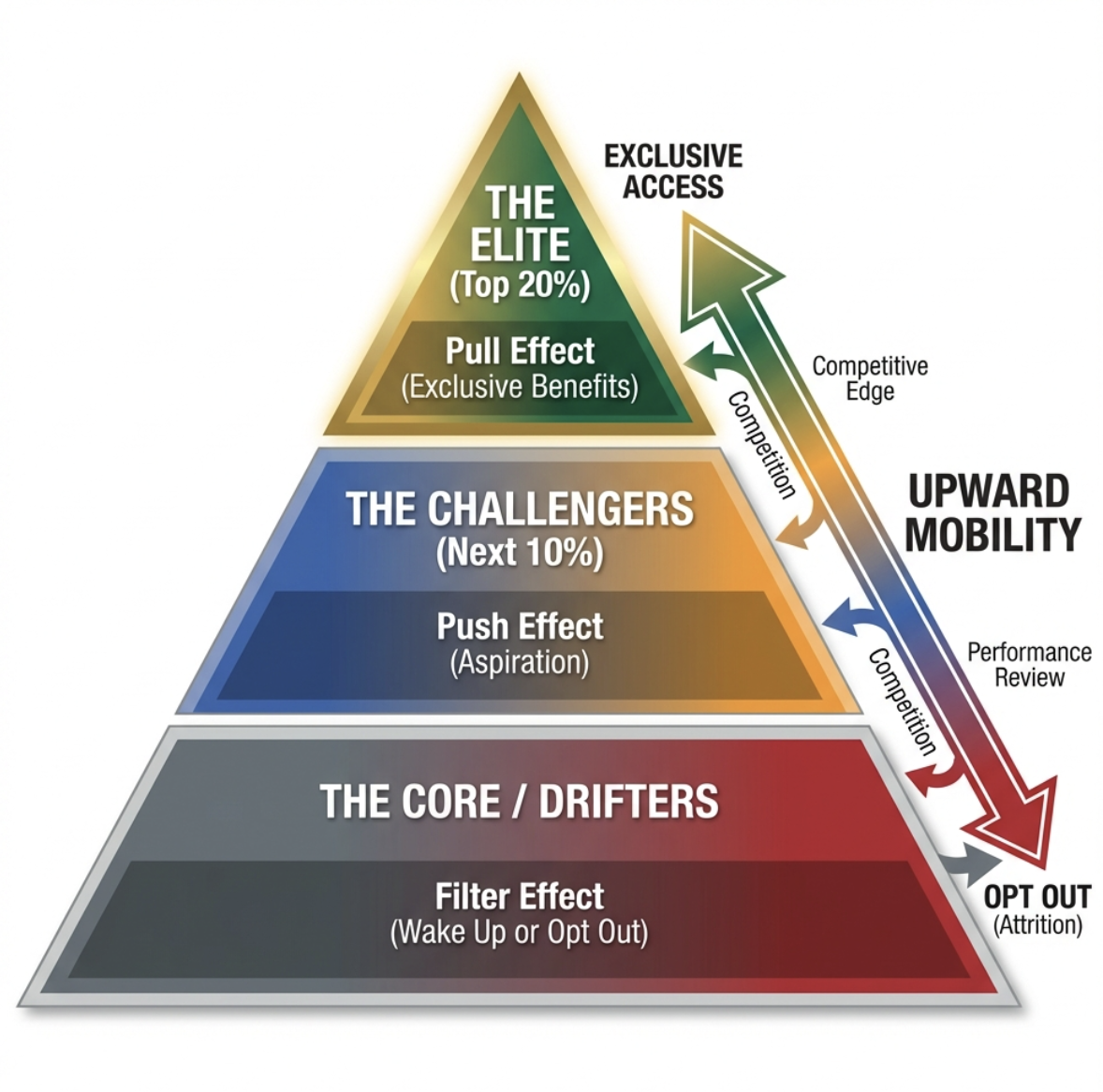
This dynamic creates a self-reinforcing Performance Pyramid that segments the
organization into three distinct strategic zones, each driven by specific "Push" and "Pull" incentive
effects:
The Performance Pyramid Segmentation
1. The ELITE (Top 20%) - "The Pull Effect"
Strategic Incentive: Exclusive Club Benefits
These agents sets the pace. To maintain their status, managers should apply exclusive
incentives (e.g., higher commission tiers, special access, elite recognition). The fear
of losing these exclusive privileges creates a powerful "Pull Effect" that motivates the top 20% to
fight to stay at the summit.
2. The CHALLENGERS (Next 10%) - "The Push Effect"
Strategic Incentive: Aspiration to Join the Elite
This segment is close enough to taste victory. Their desire to break into the "Exclusive Club"
creates a "Push Effect" from below, forcing the Elite to keep improving to avoid being overtaken.
This tension is the engine of collective growth.
3. The CORE / DRIFTERS (Bottom 20% - 50%) - "The Filter Effect"
Strategic Incentive: Wake Up or Opt Out
For the bottom tier, the open leaderboard serves as an unignorable reality check. The transparency
filters out those not serious about the business (leading to natural attrition) while serving as a
wake-up call for potential performers. Crucially, the dashboard provides Data-Backed Success
Models from the Top 20% that anyone can study, creating a "Learning Pull" for those
willing to do the work.
Strategic Implication: Rather than the manager manually pushing every agent, the
dashboard creates an ecosystem where the top pulls the middle, and the middle pushes the top, turning
performance management into a self-sustaining cycle. In essence, motivation can be automated when the
right conditions are in place.
6.Implementation Framework
6.1Activity Builder Integration
The SPD framework integrates seamlessly with Producer Framework's Activity Builder through several key
components:
Template Engine: Supports n-metric templates with flexible key metric designation
Calculation Engine: Real-time SPD computation with configurable parameters
Visualization Layer: Traffic-light dashboard with drill-down capabilities
API Layer: RESTful interfaces for third-party integrations
6.2Algorithmic Implementation
Algorithm 1: SPD Calculation in Activity Builder
Input: Template T, Metrics M = {m₁, ..., mₙ}, Targets TG = {tg₁, ..., tgₙ},
Actuals A = {a₁, ..., aₙ}, Weights W = {w₁, ..., wₙ}
Output: Overall SPD, Individual SPDs, Zone Classifications
1. Validate template configuration and metric types
2. For each key metric i:
a. Calculate SPDᵢ = (tgᵢ - aᵢ) / tgᵢ × 10
b. Handle ratio metrics with percentage calculations
c. Classify zone based on configurable thresholds
3. Calculate Overall SPD = √[Σ wᵢ × max(0, SPDᵢ)²] / n
4. Generate diagnostic recommendations
5. Return structured results for dashboard rendering
6.3Zone Classification System
The framework employs a traffic-light system with configurable thresholds accessible through Activity
Builder's
interface:
• Green Zone: SPD ≤ α (typically α = 0)
• Amber Zone: α < SPD ≤ β (typically β=2)
• Red Zone: SPD > β
This provides immediate visual assessment while preserving mathematical rigor and enabling organizational
customization.
7.Strategic Implications
7.1Collaborative Competitive Equilibrium Management
The SPD framework transforms management from reactive problem-solving to proactive collaborative
competitive
equilibrium orchestration. Within Producer Framework, managers become strategic orchestrators who:
1. Facilitate consensus achievement through collaborative metric template design
2. Monitor multi-level equilibrium health through real-time SPD dashboards
3. Orchestrate competitive dynamics using mobile technology for hyper-competitive
visibility
4. Enable iterative performance escalation through evidence-based metric refinement
7.2Real-Time Organizational Health Monitoring
The framework's most strategically powerful application lies in organizational health monitoring through
time-series SPD analysis. Mobile technology enables unprecedented real-time observability across
organizational
levels:
Individual Agent Health: SPD patterns reveal whether agents maintain sustainable
equilibrium or
experience strategic dysfunction.
Manager Team Effectiveness: Aggregated team SPD trends indicate coaching relationship
quality
and competitive environment health.
Director-Level Orchestration: Organization-wide SPD patterns enable strategic
intervention
before performance degradation becomes systemic.
Temporal Analysis Framework:
• 3-month SPD trends: Early intervention signals and consensus quality assessment
• 6-month patterns: Team dynamics evaluation and competitive equilibrium stability
• 1-year trajectories: Sustainable performance validation and organizational learning
capture
7.3Hyper-Competitive Performance Orchestration
Unlike traditional target-achievement models, SPD within Producer Framework creates hyper-competitive
performance
orchestration through:
Real-Time Competitive Visibility: Mobile observability enables instant performance
benchmarking,
creating productive competitive tension that drives collective performance upward.
Equilibrium-Preserved Competition: Competitive dynamics operate within SPE framework,
ensuring
competition enhances rather than destroys individual and relational equilibrium.
Collaborative Learning Networks: High-performing agents' SPE models become
organizational
assets, enabling evidence-based performance replication rather than assumption-based coaching.
Dynamic Performance Escalation: Iterative consensus cycles create upward performance
spirals
where competitive excellence drives continuous metric and target refinement.
8.Limitations and Extensions
8.1Current Limitations
1. Assumption of rational agents: Real agents may exhibit bounded
rationality
2. Static equilibrium concept: Dynamic equilibria may be more realistic
3. Limited behavioral modeling: Psychological factors remain
underexplored
4. Platform dependency: Full benefits require Producer Framework ecosystem
adoption
5. Optimality-Stability Divergence: The framework assumes "Optimal Outcome"
(Management's Goal) aligns with "Nash Equilibrium" (Stable Outcome). In practice, without
rigorous
incentive design (provided by the Consensus Game layer), these may diverge (e.g., via
sandbagging).
8.2Future Research Directions
1. Behavioral extensions: Incorporating prospect theory and behavioral biases within
collaborative consensus dynamics
2. Dynamic SPE: Time-varying equilibria and path-dependent performance modeling in
hyper-competitive environments
3. Network effects: Modeling performance spillovers in complex team structures with
real-time observability
4. Machine learning integration: Predictive SPE modeling using Producer Framework's
competitive dynamics data lake
5. Cross-platform compatibility: API standardization for broader ecosystem
integration and competitive benchmarking
6. Psychological resilience modeling: Understanding sustainable performance under
hyper-competitive pressure
7. Consensus optimization algorithms: Automated frameworks for achieving
manager-agent strategic alignment
9.Conclusion
Strategic Performance Distance (SPD) transforms sales performance management from a reactive,
target-tracking exercise into a proactive discipline of equilibrium orchestration. By operationalizing
Nash Equilibrium concepts within the Producer Framework, we have demonstrated that sustainable high
performance is not merely a function of individual effort, but the mathematical result of aligning
manager consensus, agent capacity, and competitive dynamics.
This framework redefines the role of technology in sales: rather than simply monitoring activity, it
must create the conditions for "Strategic Performance Equilibrium." Future advancements will likely
expand this model through behavioral economics and machine learning, but the fundamental value remains
clear: when organizations shift focus from enforcing quotas to orchestrating equilibrium, they unlock a
more resilient, continuously improving path to revenue excellence.
Acknowledgments
The author acknowledges the assistance of advanced
artificial intelligence systems in the drafting, formatting, and structural refinement of this
whitepaper. All strategic concepts, theoretical frameworks, and final editorial decisions remain
the sole responsibility of the author.
References
Koh, S. (2025). Producer Framework: Activity Builder module implementation
guide. Internal Technical Documentation.
(Source for technical implementation details within
Producer Framework)
McKelvey, R. D., & Palfrey, T. R. (1995). Quantal response equilibria for
normal form games. Games and Economic Behavior, 10(1), 6-38.
(Basis for "bounded rationality" considerations in the
limitations section)
Monderer, D., & Shapley, L. S. (1996). Potential games. Games and
Economic Behavior, 14(1), 124-143.
(Foundational mathematical concept for SPD's gradient
ascent logic)
Myerson, R. B. (1991). Game theory: Analysis of conflict. Harvard
University Press.
(Standard reference for strategic interaction modeling
definitions)