
Why We Created the Strategic Performance Distance (SPD)
- You're Already Running Sales Builder Well
- Understanding SPD in 60 Seconds
- What SPD Looks Like in Practice
- How SPD Actually Works: The Design
- Why Early Detection Matters: The Business Case
- What Makes SPD Different
- Consensus Targeting: Trust Through Personalization
- What We Expect: Rising Performance IQ
- What We Built: Activity Builder
- Where This Leads
- Next Steps
You're Already Running Sales Builder Well
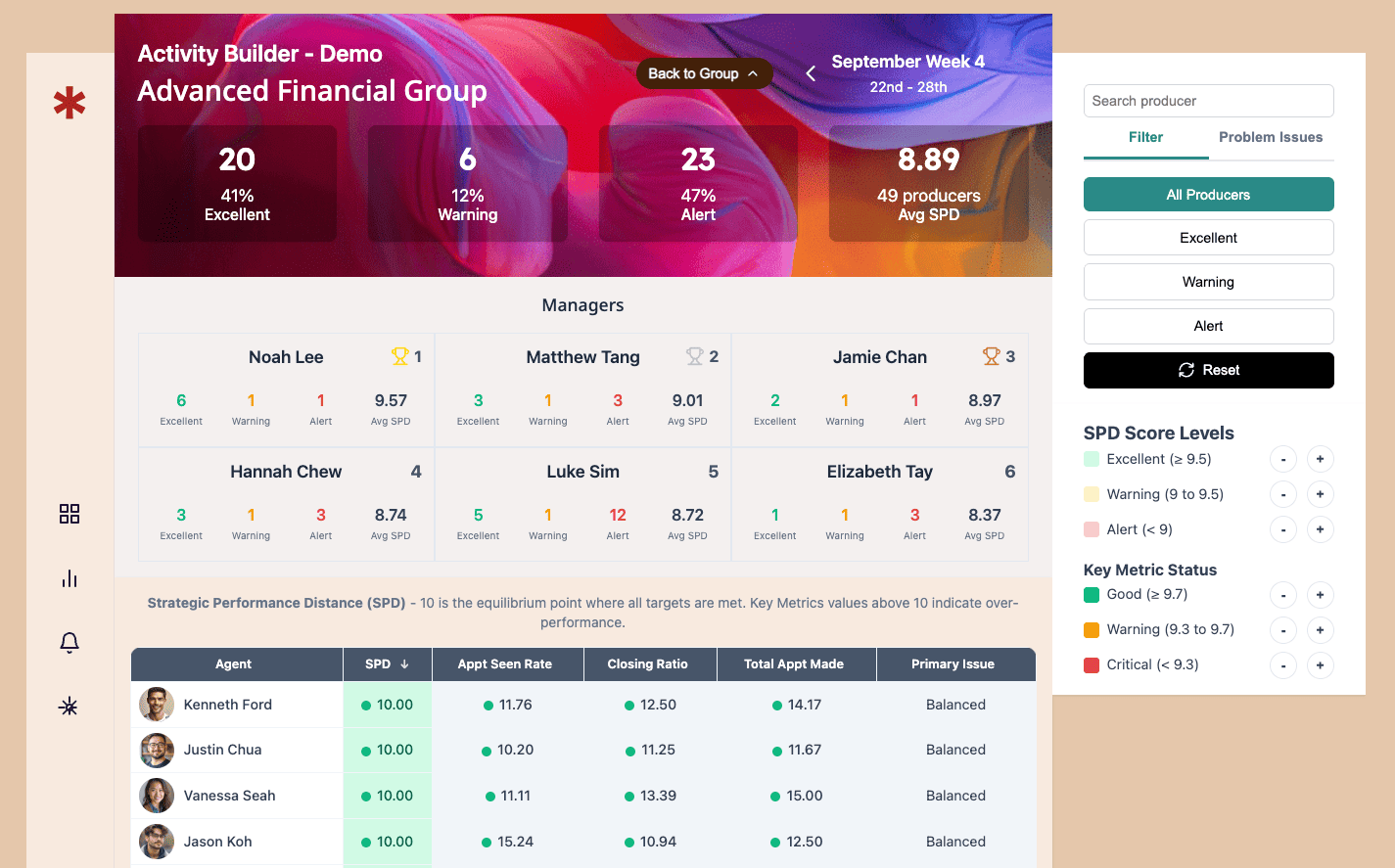
Your system works. Customized metrics, color-coded ratios, effective weekly sessions.
But some questions remain hard to answer:
Who's trending down over the last 4 weeks? Is this a real pattern or just a bad week? Who needs support before momentum is lost? Are we missing someone who needs help?
More insights exist in your data. Extracting them requires significant tech investment.
This is why we created SPD. Instant visibility into who needs attention. Drill into detailed data with one tap. Navigate efficiently.
Understanding SPD in 60 Seconds
SPD is like a vital sign for sales performance—10 means equilibrium, all targets met.
While the threshold can be tuned, here's how to read it:
- 10.00 = Perfect health → At equilibrium, balanced performance
- 9 to 9.99 = Green zone → Excellent, maintain current approach
- 7 to 8.99 = Yellow zone → Warning, monitor closely
- Below 7 = Red zone → Immediate intervention required
What SPD Looks Like in Practice
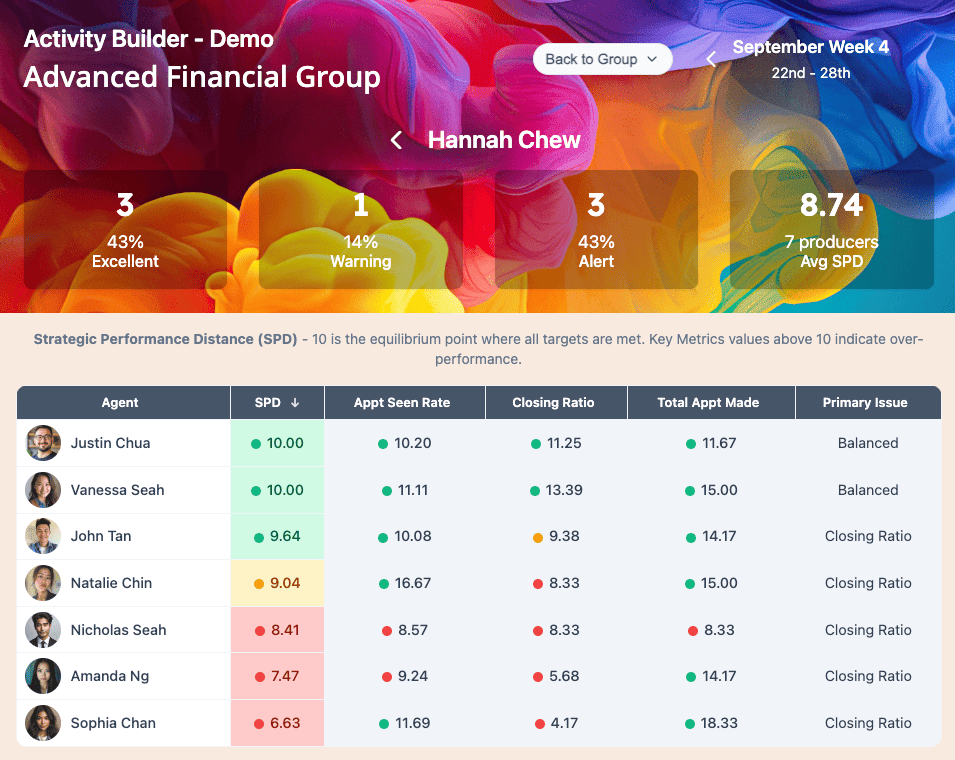
What you see at a glance:
- 4 red zone agents (SPD: 7.46, 7.62, 8.20, 8.29) → Urgent intervention needed
- 1 yellow zone (SPD: 9.64) → Monitor this week
- 5 green zone (SPD: 9.85 to 10.00) → Healthy performance
The deeper insight: All four critical cases struggle with the same metric—Closing Ratio. This is a team training opportunity.
The time advantage is immediate. More importantly, knowing which specific skill needs attention changes how you prepare, run sessions, and make strategic decisions.
How SPD Actually Works: The Design
The core principle: Over-performance in one area cannot offset under-performance in another.
An agent making 150% under "appointments made" but only 20% closing ratio isn't "balanced" despite strong activity levels. That's someone who needs specific help.
SPD measures only shortfalls from targets. Exceeding one metric gives zero credit to mask weakness elsewhere. Every metric must hit its target for equilibrium.
What this gives you: Surgical precision on which specific skill needs attention. Complete visibility across your team and organization.
Why Early Detection Matters: The Business Case
The real value of SPD isn't just saving prep time—it's protecting revenue and retaining your best people through pattern recognition.
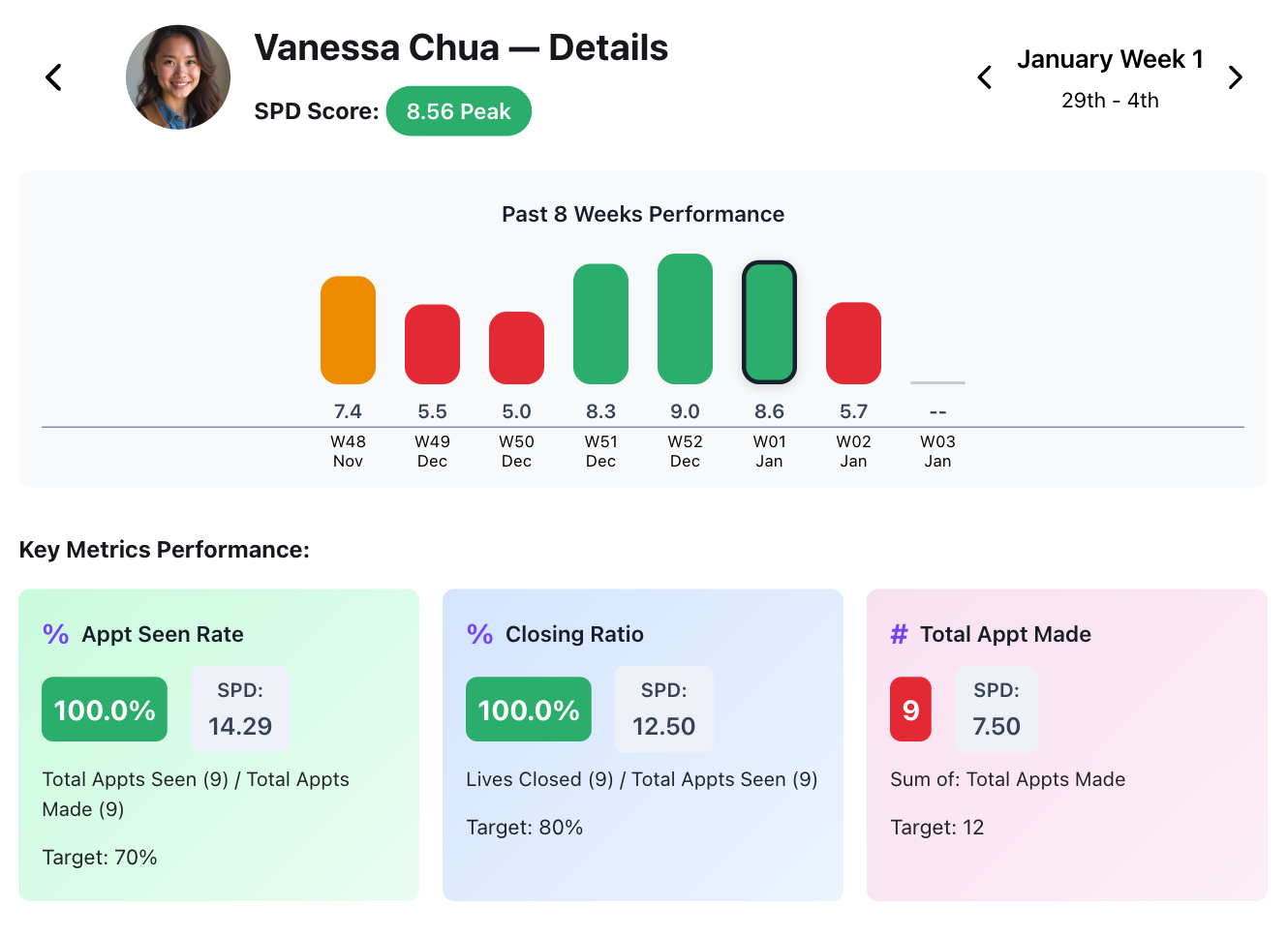
4-Week Trending: Patterns You're Missing
Vanessa's 4-week view: Green → Green → Green → Red. This isn't variance—it's a trend. In this case, showing Red in January may not be a concern, but a 2 months Red trending in May may need early intervention.
The problem: In your Sales Builder sessions, success stories may own the airtime. Vanessa's struggle stays invisible until it's entrenched.
The insight: Past 4 weeks predicts next 4 weeks. One glance at Activity Builder reveals who needs intervention, regardless of who speaks up. Pattern detection becomes systematic, not dependent on session dynamics.
What Makes SPD Different
Self-correcting data: Funnel metrics validate each other. Inflate appointments? Closing ratio drops, flagging the inconsistency. Gaming one stage breaks the next.
One number, every level: Same formula from individual agent (SPD = 9.32) to 150-agent organization (Avg SPD = 9.55). Everyone speaks the same language.
Built to evolve: Weight metrics differently? Adjust aggregation methods? Update sales process templates? The framework adapts without rebuilding.
Consensus Targeting: Trust Through Personalization
High Net Worth (HNW) specialist needs 6 appointments/week. General market agent needs 12. Both can excel—one formula, different baselines.
How it works: You and each agent set targets collaboratively. Activity Builder records consensus. SPD formula stays identical—only baseline targets change. Both agents hitting their targets = SPD 10.00.
Why it matters: Collaborative targets build trust. Participation creates buy-in. Trust drives retention.
What We Expect: Rising Performance IQ
Shared vocabulary creates shared understanding. When agents speak "SPD," "Green Zone," "Red Zone," they self-diagnose. "My closing ratio is pulling my SPD down" replaces waiting for your feedback.
The shift: Your cognitive load decreases. Agents become clear and confident about what activities they need, what support to request, what skills to develop. They self-manage toward equilibrium.
Your role evolves from constant pushing to strategic coaching. That's the productivity gain—agent autonomy plus cultural elevation.
What We Built: Activity Builder
SPD embedded in a platform built for financial services distribution, not generic CRM.
Core capabilities: Customizable templates for your sales process. Mobile-first real-time updates. Consensus-based target framework. 12-week trending without tab gymnastics.
Design philosophy: Coaching tool, positive reinforcement. Built to help agents succeed.
Where This Leads
Instant clarity across diverse business models. No manual consolidation.
The shift: From "Did you hit your target?" to "How can we help you succeed?"
Next Steps
For the mathematical foundations and game theory framework behind SPD, see our academic whitepaper: "Strategic Performance Distance: A Nash Equilibrium-Inspired Framework for Sales Performance Management"
Ready to see SPD in action?
Contact our solutions team for a demonstration of Producer Framework's Activity Builder, or to discuss how SPD could work within your specific organizational context.
About the Author